Python, Streamlit, Scikit-learn, Random Forest, SVM, FastAPI, Matplotlib, Joblib, Pandas
This project is a real-time anomaly detection dashboard built to monitor and detect cyber threats in Internet of Medical Things (IoMT) environments. By leveraging machine learning, it provides a vital layer of security for smart hospital systems.
As healthcare systems become increasingly connected, they also become more vulnerable to cyberattacks. I created this dashboard to provide healthcare IT professionals with a real-time tool to detect and visualize anomalies—such as spoofing, unauthorized access, and ransomware—before they can compromise patient safety or data.
What it does
The IoMT Anomaly Detection Dashboard offers a suite of tools for real-time monitoring and model evaluation:
Real-time Simulation: Simulates IoMT data streams to provide live predictions on network health.
Dual-Model Detection: Utilizes both Random Forest and Support Vector Machine (SVM) models to identify anomalies.
Model Evaluation: Displays live confusion matrices to help researchers understand model performance.
Automated Logging: Maintains a detection_log.csv of all predictions for post-incident analysis and performance auditing.
Demo
How I built it
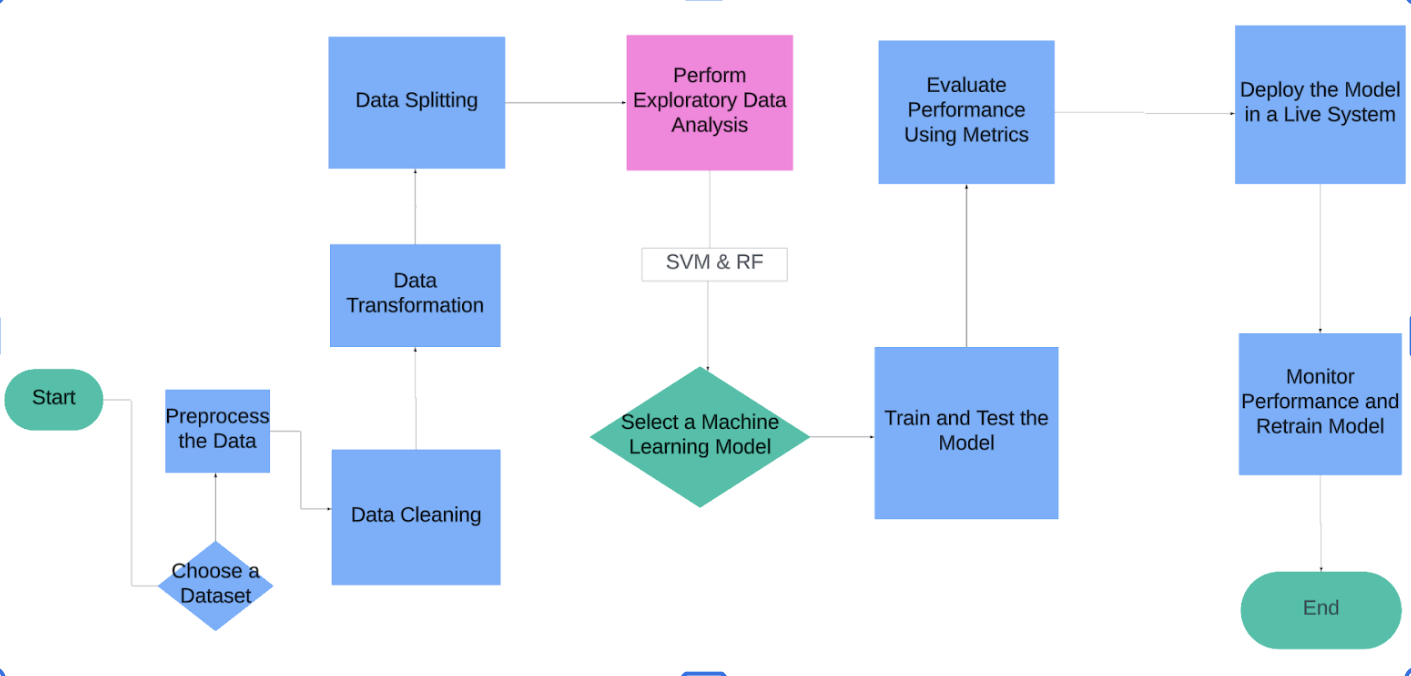
Data Source: IoMT.csv dataset containing labeled network traffic patterns.
Machine Learning: Developed using Python and Scikit-learn, focusing on Random Forest and SVM classifiers for high-accuracy threat detection.
Dashboard: Built with Streamlit to create an interactive, web-based UI that handles live data processing.
Preprocessing: Utilized StandardScaler and Joblib for efficient model serialization and real-time feature scaling.
Architecture
Challenges I ran into
Real-time Performance: Ensuring the dashboard could process and visualize data points rapidly without lag.
Model Accuracy: Tuning the SVM model to minimize false positives, which are critical in a healthcare setting to avoid “alert fatigue.”
Data Structuring: Handling the specific feature requirements of medical IoT devices while maintaining a clean preprocessing pipeline.
Accomplishments that I am proud of
Successfully integrated two distinct ML models into a single, cohesive dashboard.
Developed a functional logging system that records threats automatically.
Created a tool that bridges the gap between complex machine learning research and practical cybersecurity application.
What I learned
How to deploy machine learning models into a live Streamlit environment.
The specific characteristics of IoMT network traffic and how they differ from standard IT environments.
Advanced visualization techniques for displaying model evaluation metrics like confusion matrices in real-time.
What is next for IoMT Dashboard
Integrate the FastAPI backend to support remote data ingestion from actual medical devices.
Implement deep learning models to better detect time-series based attack patterns.
Add an automated alert system that sends notifications via email or SMS when high-severity threats are detected.